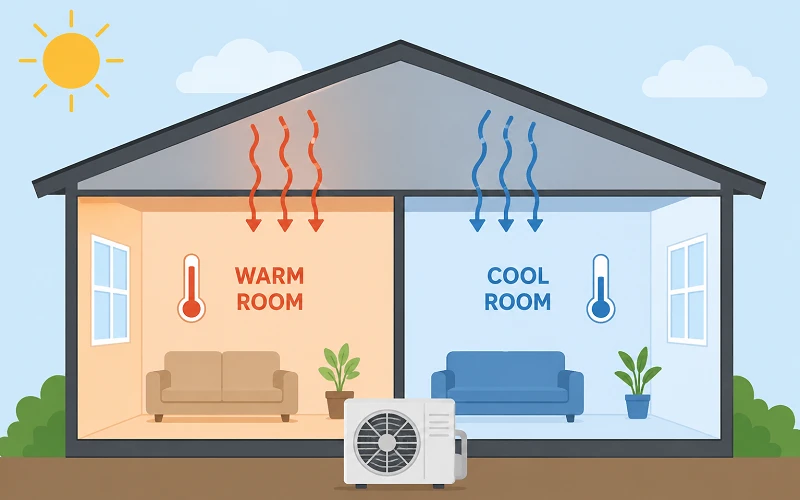
Many homeowners assume that an air conditioner should cool every room the same way, as long as the system is powerful enough. That seems reasonable on the surface. The thermostat gets set, the AC turns on, and cool air starts moving through the house. Yet some homes still feel uneven. One room stays comfortable while another feels warm all afternoon. Upstairs spaces may hold heat long after sunset. Some areas cool quickly, while others seem to fight the system all day.
In many of these cases, the air conditioner is not the only issue. Uneven insulation levels throughout the home often create the kind of heat imbalance that makes cooling systems work harder than they should. The AC then has to chase comfort in a home that keeps gaining heat at different rates in different places.
This matters because insulation does more than help with energy use. It directly affects how stable indoor temperatures feel. A cooling system can only do so much if parts of the home allow outside heat to move in faster than the AC can remove it. That is why uneven insulation often leads to uneven comfort, longer cooling cycles, and more strain on the equipment.
What Uneven Insulation Really Means
Uneven insulation does not always mean a home has no insulation at all. In many cases, it means certain areas are protected well, while others are not. One section of the attic may have solid coverage while another has thin or disturbed material. One wall may resist heat well while another gets heavy sun exposure and lacks the same thermal protection. An addition, converted garage, or older room may not match the rest of the house.
This creates an uneven thermal barrier. Some areas slow down heat gain effectively. Others allow heat to move in much more easily. The result is a house that does not heat up evenly during the day.
That uneven heat gain changes how the AC has to perform. Instead of cooling one balanced indoor environment, the system ends up trying to manage multiple indoor conditions at once.
Why Air Conditioners Depend on a Stable Indoor Environment
An air conditioner works by removing heat from the indoor air and releasing it outside. It performs best when the home itself helps slow heat from coming back in. Insulation plays a major role in that process.
When insulation levels remain consistent, the home resists outside heat more evenly. The cooling system can then maintain a steadier indoor temperature with fewer surprises. Rooms cool at a more predictable pace. Airflow feels more balanced. The thermostat gets a more accurate picture of what the house needs.
With uneven insulation, that stability disappears. One room may gain heat rapidly through the ceiling or exterior wall while another stays relatively cool. The thermostat may sense acceptable conditions in one area while another space keeps warming up. The AC continues running because some part of the house never fully settles.
This often leads homeowners to think the AC is weak or undersized when the home envelope may be the larger problem.
Attic Insulation Often Creates the Biggest Imbalance
In hot climates, the attic often becomes one of the strongest sources of indoor heat gain. Roof surfaces absorb the sun for hours, and attic temperatures rise far above outdoor air. When attic insulation is thin, missing, or uneven, that heat transfers downward into the living space.
This can create major comfort issues, such as:
- Hot upstairs rooms
- Warm ceilings in the afternoon
- Bedrooms that never cool as quickly as the main living areas
- AC systems that keep running late into the evening
Even a small section of reduced attic insulation can make a noticeable difference. Heat does not need a huge opening to move into the home. It only needs a weak point.
Once the attic heat begins pushing downward unevenly, the AC must work harder to keep up. The system may cool the air effectively, but the house keeps feeding heat back into the rooms.
Walls With Different Heat Exposure Cool Differently
Not every wall in a home faces the same direction or receives the same amount of sun. West facing and south facing walls often absorb more heat than the shaded sides of the house. If the insulation inside those wall sections is inconsistent, the difference becomes even more noticeable.
This leads to rooms that feel warmer at predictable times of day. A home office may stay comfortable in the morning but heat up sharply after lunch. A bedroom may feel fine overnight but become difficult to cool during late afternoon sun exposure.
The AC does not know that one room is gaining heat faster through a sun loaded wall. It only reacts to the temperature around the thermostat. That disconnect is what makes uneven insulation so frustrating. The system may be doing its job, but the house itself keeps working against it.
Additions and Retrofits Commonly Have Insulation Gaps
Homes that have been expanded or remodeled often contain hidden insulation inconsistencies. A room addition may have been built under different standards than the original house. A garage conversion may have ductwork added without matching insulation upgrades. An older part of the home may hold different materials than a newer section.
These mismatched areas often become the rooms that never seem to cool correctly.
Homeowners may notice:
- One side of the home always feels warmer
- An added room needs cooler thermostat settings than the rest of the house
- The system runs longer after the addition was built
- Airflow seems normal, but comfort still feels off
This is not always an airflow issue. In many cases, the room simply gains heat faster because it does not have the same insulation strength as the rest of the home.
Uneven Insulation Can Make Airflow Problems Feel Worse
Airflow and insulation are closely connected when it comes to comfort. Even a well designed duct system can struggle to satisfy rooms that gain heat too quickly. A room with weak insulation may need more cooling than the vent system was originally designed to provide.
This creates a cycle where homeowners feel like the vent airflow must be too weak. They may close vents elsewhere or lower the thermostat to push more cooling into the warm room. The deeper problem may still be heat gain, not just air movement.
Uneven insulation often amplifies airflow complaints by causing some rooms to need far more cooling support than others. The AC may then seem unbalanced, even though the root cause involves how the home holds or loses heat.
The Thermostat Cannot See the Whole Problem
Most homes rely on one thermostat in one location. That thermostat measures the temperature in its immediate area. It does not track every ceiling, wall, or room condition throughout the house.
This becomes a major issue in homes with uneven insulation. The thermostat may be located in a relatively stable area while hotter rooms continue gaining heat. The system may cycle off once the thermostat area reaches the target, even though other rooms still feel warm.
Homeowners then start changing settings throughout the day because the house feels inconsistent. They may lower the thermostat to cool hot rooms and later raise it because shaded rooms become too cold.
This pattern often points to a thermal imbalance inside the house, not just a control problem.
Longer Run Times Do Not Always Mean the AC Is Failing
One of the most common reactions to long AC run times is to assume the air conditioner is wearing out. That can happen, but uneven insulation often causes the same symptom. The system may run for long periods simply because the home keeps taking on heat unevenly and continuously.
This is especially noticeable during:
- Long hot afternoons
- Days with strong roof and wall exposure
- Early evenings when the structure still releases stored heat
- Heat waves that expose the weakest insulated parts of the home
The AC keeps trying to catch up, but the poorly insulated zones keep resetting the comfort problem.
That kind of workload increases strain on the system, even if the unit itself is still in decent shape.
Why Uneven Insulation Raises Cooling Strain Over Time
Air conditioners are designed to cool homes, but they are not meant to battle preventable heat gain every hour of the day. Uneven insulation makes the system work harder and longer, which can increase wear on major components over time.
That added strain may affect:
- Compressor workload
- Blower run time
- Cooling cycle length
- Temperature consistency
- Indoor comfort recovery after peak heat
A home that gains heat unevenly creates a less efficient operating environment for the cooling system. The AC then spends more time correcting problems caused by the structure rather than simply maintaining comfort.
Signs Uneven Insulation May Be Affecting Your AC
Homeowners often notice patterns before they understand the cause. Some signs that uneven insulation may be affecting cooling performance include:
- Certain rooms always feel warmer than others
- Upstairs comfort drops much faster than downstairs
- The AC runs long, but the house still feels uneven
- Afternoon comfort becomes harder to maintain
- The thermostat gets changed often to keep rooms livable
- Rooms with strong sun exposure stay uncomfortable longer
These patterns do not always mean the AC needs major repair. They often mean the house itself is creating an uneven cooling load.
Better Insulation Helps the AC Work Smarter, Not Just Harder
Once insulation levels become more consistent, the AC often performs in a more stable way. The home resists heat more evenly, which helps the cooling system maintain temperature without constantly compensating for weak zones.
That can improve:
- Room to room comfort
- Cooling consistency
- Evening recovery after daytime heat
- Thermostat stability
- System run time efficiency
The goal is not just to make the AC stronger. It is to give the AC a home that supports its work instead of fighting against it.
Comfort Problems Often Start With the House, Not Just the Equipment
Many cooling complaints lead people straight to the air conditioner. That makes sense because it is the part of the system they hear and interact with every day. Still, uneven insulation often creates the kind of comfort issues that people wrongly blame only on the HVAC equipment.
An air conditioner can cool effectively and still struggle in a home with thermal weak points. The more uneven the insulation, the more uneven the cooling experience tends to become.
This is why solving comfort problems sometimes requires looking beyond the thermostat and beyond the AC unit. The structure of the home, especially the attic and exterior envelope, may be shaping the problem every day.
A balanced indoor environment gives the cooling system a fair chance to do its job. Without that, even a good system can feel like it is always behind.