
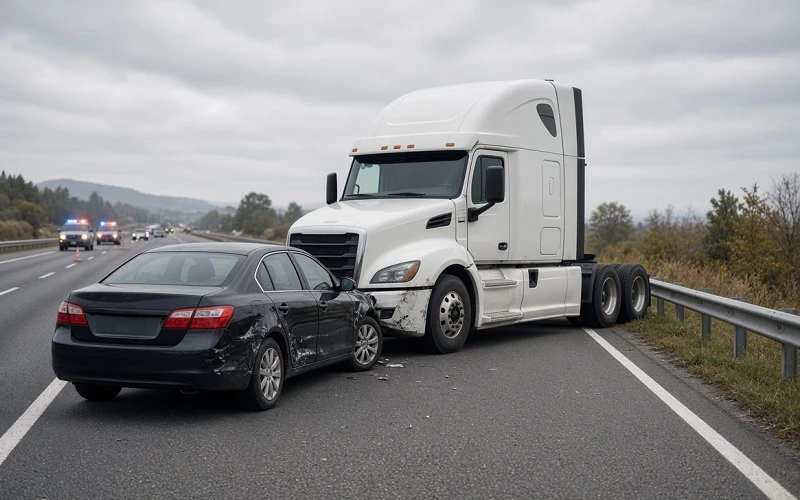
When a commercial truck is involved in a crash, the legal process differs sharply from a standard car accident. The size of the vehicles, the severity of injuries, the number of potentially responsible parties, and federal trucking regulations all create greater complexity.
Injured people often face serious medical recovery, mounting bills, and lost income at the same time. Understanding the key differences can help them ask better questions as they consider next steps.
Important: This article provides general information only. It is not legal advice. Laws vary by state. Anyone involved in a serious crash should consult a licensed attorney in their jurisdiction for guidance specific to their situation.
Who May Share Responsibility
Truck accident cases frequently involve more than one party. Liability does not always stop with the driver. Depending on the facts, other parties may include:
- The truck driver — for traffic violations, unsafe driving, or hours-of-service breaches
- The motor carrier — for hiring practices, training, supervision, or pressure that contributed to unsafe conditions
- Cargo loaders or shippers — if improperly secured or overloaded freight played a role
- Maintenance providers — if neglected repairs or overlooked mechanical problems contributed
- Manufacturers — in cases involving alleged defects in brakes, tires, or other components
Identifying all potentially responsible parties usually requires a prompt investigation. Records and electronic data can change or disappear quickly. Trucking companies and insurers often send response teams within hours of a serious crash.
Federal Regulations and Their Role
The Federal Motor Carrier Safety Administration (FMCSA) sets detailed rules for commercial trucking. These cover driver qualifications, hours of service, vehicle maintenance, cargo securement, and electronic logging devices.
A violation of these rules that contributed to a crash can serve as evidence of negligence. The Federal Motor Carrier Safety Administration maintains a public database of carrier safety records and inspection histories that forms a critical part of the investigation in any serious truck accident case. Investigators often review public carrier safety records and inspection histories. A carrier’s prior safety record may form part of the overall picture, though every case turns on its specific facts.
Injury Severity and Potential Damages
A fully loaded commercial truck is many times heavier than a passenger vehicle. Collisions involving this weight difference can produce severe injuries, including traumatic brain injuries, spinal cord damage, complex fractures, and internal injuries.
Not every truck crash causes catastrophic harm, but the potential is higher than in many ordinary car accidents. Cases involving long-term medical needs, disability, or lost earning capacity can involve substantial economic damages. Accurate assessment of future costs is an important part of evaluating any claim.
Preserving Time-Sensitive Evidence
Certain evidence in truck cases is highly time-sensitive. Examples include:
- Electronic logging device (ELD) data
- GPS and telematics records
- Onboard camera footage
- Driver qualification and employment files
- Vehicle inspection and maintenance records
These materials can be overwritten, lost, or altered if parties do not preserve them promptly. Formal preservation requests (often called spoliation letters) are commonly used to protect this evidence early in the process.
Getting Legal Help After a Commercial Truck Crash
Getting legal help after a commercial truck crash from a firm with specific experience in trucking litigation is the most important step any seriously injured person can take. The trucking industry defends these cases with specialized legal teams and substantial resources. Matching that level of preparation on the plaintiff side is not optional. It is the baseline requirement for a fair process.
Final Notes
Commercial truck accident claims often differ from ordinary car accident claims in several ways: the number of potentially responsible parties, the role of federal safety rules, the severity of injuries that can occur, and the importance of early evidence preservation.
This overview is for educational purposes only. It does not create an attorney-client relationship and should not be relied upon as legal advice. For guidance on a specific incident, consult a licensed attorney in the relevant jurisdiction.
Disclaimer:
This article is for general informational and educational purposes only. It does not constitute legal advice, does not create an attorney-client relationship, and should not be relied upon as a substitute for advice from a licensed attorney. Laws vary by state and change over time. Every case depends on its specific facts. If you have been involved in a commercial truck crash or any personal injury incident, consult a qualified attorney licensed in your jurisdiction for advice tailored to your situation.