
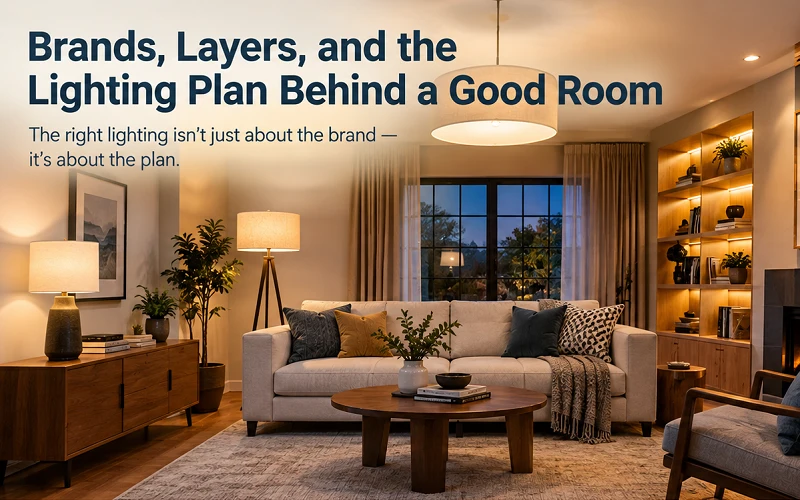
When people browse for fixtures, they usually start with names: which makers are popular, which ones suit a modern look, which ones fit a budget. That is a reasonable starting point, but the best results come when you decide what each light needs to do before you pick a brand. Lighting designers describe a room in three layers, and thinking this way makes every brand decision easier.
The three layers
A layered light explainer from CNET describes the three layers lighting designers rely on: ambient, task, and accent. Ambient lighting is the main light in a room. It can come from floor lamps, recessed lights, chandeliers, or ceiling fans, and it should fill the room enough that you are not stumbling in the dark. Task lighting illuminates a specific area, such as a reading lamp beside a chair, the lights around a bathroom mirror, or a pendant over a kitchen sink. Accent lighting is mostly about looks, highlighting a fireplace, a bookshelf, or a piece of art.
Why this matters when comparing brands
Some of the top lighting brands are known for ambient pieces such as chandeliers and large pendants. Others are known for task lamps, sconces, and adjustable arms. Still others make small accent fixtures and strip lights. If you shop by layer, you can pick the right strength from each company instead of forcing one brand to do everything.
A living room might use a statement ceiling fixture from one maker, table lamps from another, and picture lights from a third. As long as the finishes and proportions feel related, the room will read as one coherent design.
Getting the balance right
Layers only work if they are balanced. The explainer suggests a helpful rule for accent lighting: choose a bulb two to three times brighter than the rest of the space so the highlighted object actually stands out. If every light in the room is equally bright, nothing looks special, and the room can feel flat.
Dimming helps with balance. When the ambient layer can be lowered for a movie night and raised for a party, the same room serves several purposes. Smart switches and scenes can make that adjustment effortless, but a simple dimmer on the main light already goes a long way.
Color temperature and task lighting
Color temperature matters most in task lighting. A cooler, daylight-toned bulb suits precise work like crafting or building. For reading, a warmer bulb is easier on the eyes. Because the Kelvin number is printed on most bulb packaging, it is easy to check before you buy. Try to keep the ambient and accent layers in a similar warm range so the room feels unified.
A room-by-room starting point
- Living room: a central or floor-based ambient source, a lamp near each seat, and one accent light on art or shelves.
- Kitchen: bright, even ambient light with focused task light over prep areas and the sink.
- Bedroom: soft ambient light, bedside reading lamps, and a gentle accent such as a wall sconce.
- Bathroom: even light around the mirror, with a dimmable ambient source for evenings.
- Home office: a good desk lamp first, then ambient light that avoids screen glare.
Build the plan, then shop
Write down what each room needs in each layer. Then look for fixtures that fit. You may find that one brand covers two layers well and you only need to look elsewhere for the third. That is a more efficient way to shop than starting with a brand and trying to fit it into the room.
The takeaway
Brand names are useful shorthand, but a lighting plan matters more. Think about ambient, task, and accent light for each room, keep the color temperature consistent, and make sure you can dim the main source. Once you have that framework, choosing among brands becomes a matter of picking the right tool for each job, not guessing which logo looks best. The result is a home that is easier to live in and more pleasant after dark.