
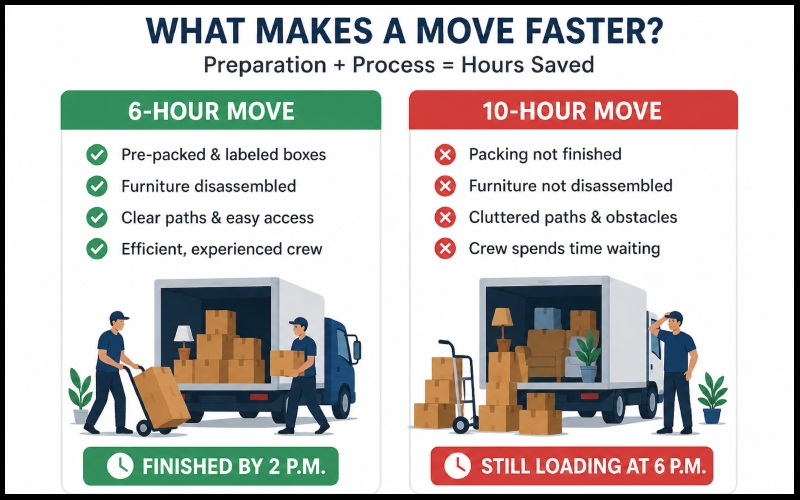
Two families. Same neighborhood. Same size home. Same crew arrives at 8 a.m.
One is finished by 2 p.m. The other is still loading at 6.
The truck did not change. The distance did not change. The crew did not change. So what shifted four hours of someone’s afternoon into someone else’s evening?
Most of the time, it is preparation. The kind of preparation nobody talks about because it does not look like preparation while you are doing it.
This is where those four hours hide.
Where the Hours Hide
Moving day breaks into four chunks of time. Loading. Driving. Unloading. And the small gaps between them, which add up to more than people expect.
Loading is where the biggest variability lives. As Redfin’s packing timeline guide points out, the work that determines move-day speed happens in the weeks before, not on the day itself. The difference is not the crew. It is what the crew finds when they walk in.
A clean load looks like this. Boxes are sealed, labeled, and stacked by room. Furniture is disassembled or marked for disassembly. Pathways are clear. The crew picks up, walks straight to the truck, loads, and repeats.
A slow load looks like this. Boxes are still being packed when the crew arrives. Some are taped, some are not. A drawer of clothes is dumped on the bed. The crew waits. Or worse, the crew helps pack while billing by the hour.
That single difference, ready vs. not ready when the crew shows up, drives most of the time variation between similar moves.
What Separates a Slow Move From a Fast One
Speed on moving day does not come from working harder. It comes from removing decisions and obstacles.
The fastest moves have three things in common. Items are pre-sorted. Furniture is pre-disassembled. And the crew runs an efficient process from minute one, because experienced crews compound the prep into measurable hours saved.
The slow moves have the opposite. Items get sorted on moving day. Furniture gets disassembled on moving day. And a generic crew with average tools moves at average speed regardless of how organized the rest of the day is.
You can do everything right and still have a slow move if the crew brings a slow process. And you can be only partially prepared and still have a fast move if the crew shows up with the right equipment, the right number of people, and a routine that does not waste motion.
The Prep That Saves You Two Hours
The single biggest move-day time saver is something most people skip: a label-by-room system that the crew can read at a glance.
NerdWallet’s 2026 moving checklist covers the same logic across its pre-move sections. Boxes labeled by destination room let crews bypass the sorting step entirely on the unload side. They walk in, drop the box where the label says, and move on. No questions, no piles in the entryway, no need to come find you mid-carry.
Other prep that compounds:
- Empty drawers, even if movers say they can carry them full. Empty drawers mean lighter pieces, faster carries, and fewer breaks
- Disconnect appliances before the day. Each unhooked appliance is a separate task that eats fifteen minutes if it gets done on the day instead
- Clear pathways. Anything in the hallway, on stair landings, or near the door slows the carry-out by a factor most people do not see
- Hold a parking spot for the truck close to the door. Every extra ten feet of carry distance, multiplied by fifty trips, becomes its own hour
These do not look like much individually. Together they shave a couple of hours off a typical job.
When Crew Efficiency Pays For Itself
Crew efficiency is a real factor, and it varies a lot between companies.
Some crews have systems. They walk in, do a quick walkthrough, assign zones, and start moving. Furniture pads come out before the first piece is touched. Dollies appear without anyone asking. The truck gets loaded in the order it will be unloaded, which saves an hour at the back end.
Other crews do not. They show up with the right number of people but no routine. They figure out the move as they go. The job gets done, eventually, but it takes longer.
This is the part where hiring matters more than people think. Booking the most efficient movers for the job translates into measurable hours saved on the back end, especially when the crew works your area regularly and knows the neighborhoods, parking situations, and access patterns going in.
The cost difference matters because most local moves are billed by the hour. A four-hour move at $150 per hour is $600. The same job at six hours is $900. The crew that finishes faster often costs less in total even when its hourly rate runs slightly higher.
What You Can Do Before They Arrive
A short version of the prep, for the weekend before the move:
- Pack everything that does not need to be reachable for the next 48 hours
- Label boxes by destination room on at least two sides
- Disassemble what you can: bed frames, shelves, dining tables
- Clear hallways and stair landings
- Have a “first night” box set aside that goes in the car, not the truck
- Confirm parking and access at both ends
The list looks small. It is the difference between six hours and ten.
The Math of a Faster Move
Most moves are built to run on the original quote. If yours runs on the original quote, you are paying as estimated. If it runs over, every additional hour shows up on the final invoice.
So the math is simple. Time spent prepping the night before is time you do not pay for the next day. A few hours of evening prep typically save a couple of hours of crew time. At typical local hourly rates, those saved hours add up to several hundred dollars of cost avoided.
Six-hour moves do not happen by accident. They happen because the household and the crew both came ready.