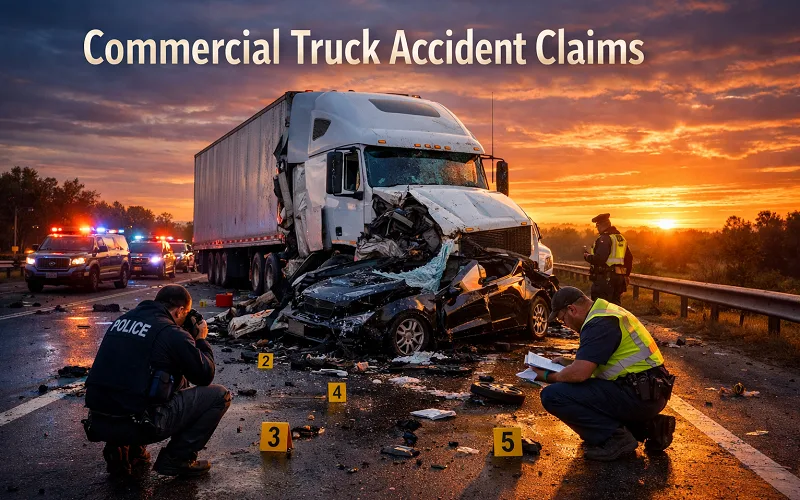
When a commercial truck is involved in a crash, the legal and investigative process that follows is fundamentally different from a standard two-vehicle accident. The scale of the vehicles, the severity of the injuries, the number of potentially liable parties, and the regulatory framework governing commercial trucking all combine to create a case that requires specialized knowledge to pursue effectively.
For the people injured in these crashes, often some of the most serious injuries seen in personal injury litigation, that complexity is not an abstraction. It is the practical reality they navigate while also dealing with recovery, medical bills, and lost income.
Who Can Be Held Liable in a Commercial Truck Crash
One of the defining characteristics of truck accident litigation is the potential for multiple defendants. Unlike a car crash where liability typically flows primarily to the other driver, a commercial truck crash may involve:
- The truck driver: For violations of traffic laws, hours of service rules, or safe driving practices
- The motor carrier: For negligent hiring, inadequate driver training, failure to enforce compliance with federal safety regulations, or pressure on drivers to violate rest requirements
- The cargo loading company: For improperly secured or overloaded freight that shifted during transport and contributed to the crash
- The maintenance contractor: For failure to identify and repair a mechanical defect that contributed to the crash
- The vehicle or parts manufacturer: For defective components such as brake systems, tires, or electronic stability systems
Identifying all liable parties requires a prompt and thorough investigation before evidence is lost, records are altered, and vehicles are repaired. The window for this investigation is short, because trucking companies and their insurers deploy accident response teams within hours of a serious crash.
Federal Regulations That Shape Truck Accident Claims
Commercial truck operations are governed by a comprehensive set of federal regulations administered by the Federal Motor Carrier Safety Administration. These regulations establish standards for driver qualification, hours of service, vehicle inspection and maintenance, cargo securement, and electronic logging device requirements.
When a violation of these regulations contributed to the crash, that violation is direct evidence of negligence. The Federal Motor Carrier Safety Administration maintains a public database of carrier safety records and inspection histories that forms a critical part of the investigation in any serious truck accident case. A carrier with a history of violations and prior safety-related interventions presents a different liability picture than one with a clean record.
The Severity of Truck Crash Injuries and What It Means for Claim Value
The weight differential between a fully loaded commercial truck and a passenger vehicle is often 20 to 30 times. When that mass is involved in a collision, the forces transmitted to the occupants of the smaller vehicle are enormous. Catastrophic injuries including traumatic brain injury, spinal cord damage, multiple long bone fractures, and internal organ injuries are not the exception in truck accident cases. They are common.
Those injuries produce economic damages that can reach into the millions of dollars when future medical care, long-term disability, and lost earning capacity are properly accounted for. A settlement that does not incorporate those future costs leaves the injured person covering major expenses out of pocket for years.
Getting Legal Help After a Commercial Truck Crash
Getting legal help after a commercial truck crash from a firm with specific experience in trucking litigation is the most important step any seriously injured person can take. The trucking industry defends these cases with specialized legal teams and substantial resources. Matching that level of preparation on the plaintiff side is not optional. It is the baseline requirement for a fair process.
Preserving Evidence Before It Disappears
Truck accident evidence is time-sensitive. Electronic logging device records, GPS data, onboard camera footage, driver qualification files, and vehicle inspection records are all subject to being overwritten, lost, or modified if a legal hold is not placed immediately.
An experienced truck accident attorney knows how to send spoliation letters that preserve this evidence before it disappears, and how to use it to build the most complete and compelling liability case possible.