
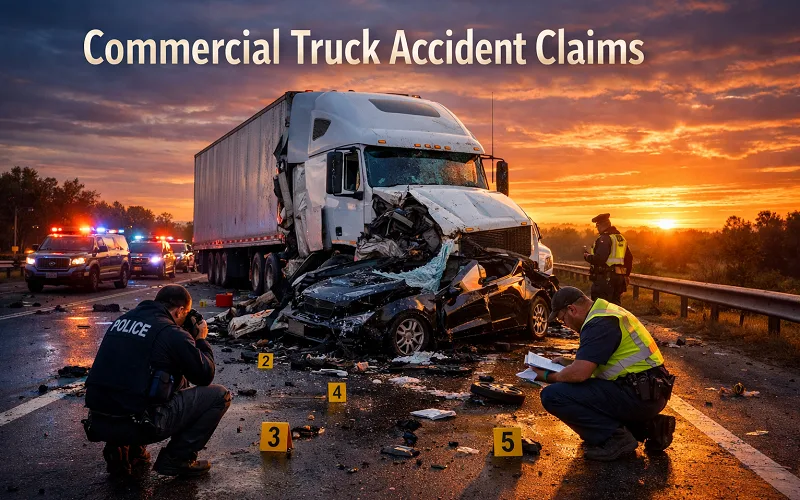
When a commercial truck is involved in a collision, the legal and investigative process that follows is often more complex than a typical two-vehicle car accident. Differences in vehicle size and weight, the potential severity of injuries, the number of parties that may share responsibility, and the detailed federal regulations that govern commercial trucking all contribute to this complexity. Getting legal help after a commercial truck crash from a firm with specific experience in trucking litigation is the most important step any seriously injured person can take.
This article provides general information about how these cases commonly differ from ordinary motor vehicle claims. It is not legal advice. Anyone involved in a serious crash should consult a qualified attorney licensed in their jurisdiction for guidance specific to their situation.
Potential Parties Who May Share Responsibility
One distinctive feature of many commercial truck cases is the possibility of multiple responsible parties. Liability does not always rest solely with the driver. Depending on the facts, other entities may also be involved, such as:
- The truck driver — for traffic violations, unsafe driving, or breaches of hours-of-service rules
- The motor carrier (trucking company) — for issues related to hiring practices, training, supervision, or pressure that may have contributed to unsafe conditions
- Cargo loaders or shippers — if improperly secured or overloaded freight contributed to the incident
- Maintenance providers — if neglected repairs or overlooked mechanical problems played a role
- Manufacturers — in cases involving alleged defects in components such as brakes, tires, or stability systems
Determining which parties may bear responsibility usually requires a prompt and careful investigation. Records, electronic data, and physical evidence can change or become unavailable over time, so early preservation efforts are often important.
Federal Safety Regulations and Their Role
Commercial trucking is regulated at the federal level primarily by the Federal Motor Carrier Safety Administration (FMCSA). These rules cover areas including:
- Driver qualifications and licensing
- Hours of service and rest requirements
- Vehicle inspection and maintenance standards
- Cargo securement
- Use of electronic logging devices
When a violation of applicable safety regulations is shown to have contributed to a crash, that fact can be relevant to questions of negligence. Publicly available carrier safety data and inspection histories are sometimes reviewed as part of a broader investigation. A carrier’s prior safety record may form part of the overall picture, though each case turns on its specific facts.
Injury Severity and Potential Damages
Fully loaded commercial trucks are significantly heavier than passenger vehicles. Collisions involving this weight difference can result in serious injuries, including traumatic brain injuries, spinal cord injuries, complex fractures, and internal injuries. Not every truck crash produces catastrophic harm, but the potential for severe outcomes is higher than in many ordinary car accidents.
In cases involving lasting medical needs, lost earning capacity, or long-term care, the calculation of economic and non-economic damages can be substantial. Accurate assessment of future costs is an important part of evaluating any claim. Settlements or resolutions that do not adequately account for ongoing needs may leave injured individuals responsible for significant expenses later.
The Importance of Preserving Evidence
Certain types of evidence in truck cases are time-sensitive. Examples include:
- Electronic logging device (ELD) data
- GPS and telematics records
- Onboard camera or dash-camera footage
- Driver qualification and employment files
- Vehicle inspection and maintenance records
These materials can be overwritten, lost, or altered if steps are not taken relatively quickly to request their preservation. Attorneys experienced in this area commonly send formal preservation (spoliation) notices to relevant parties early in the process.
Seeking Information and Guidance After a Crash
People injured in commercial truck crashes often face medical recovery, financial pressure, and complex insurance and legal questions at the same time. Because these cases can involve specialized regulations, multiple potential defendants, and technical evidence, many individuals choose to consult attorneys who are familiar with trucking litigation.
Whether or not to retain counsel is a personal decision that depends on the circumstances of each case. General information such as the content of this article cannot replace advice tailored to a specific situation. Laws vary by state, and outcomes depend on the particular facts, available evidence, and applicable legal standards.
Final Notes
Commercial truck accident claims frequently differ from ordinary car accident claims in the number of potentially responsible parties, the role of federal safety regulations, the severity of injuries that can occur, and the importance of early evidence preservation. Understanding these differences can help injured individuals and their families ask more informed questions as they consider next steps.
This overview is intended for general educational purposes only. It does not create an attorney-client relationship and should not be relied upon as legal advice. For guidance regarding a specific incident, consult a licensed attorney in the relevant jurisdiction.