
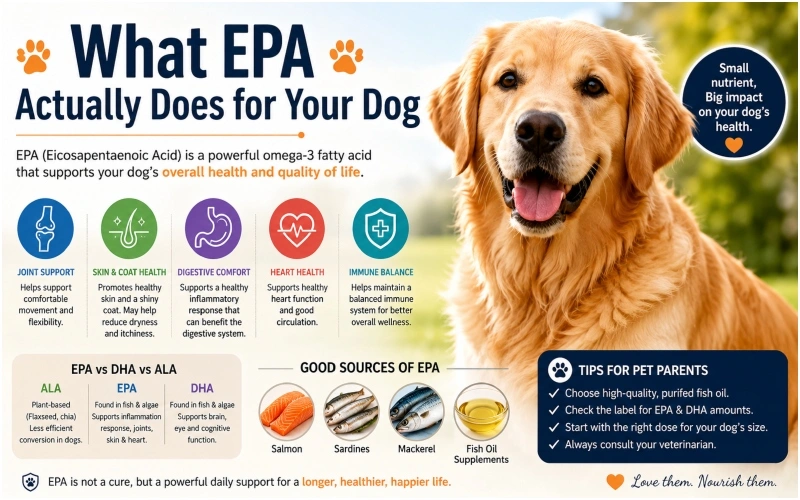
Most dog parents have heard of omega-3s by now. Fish oil comes up often in conversations about skin health, mobility, and everyday wellness support for dogs. But hiding inside that broad “omega-3” label sits a specific fatty acid called EPA, short for eicosapentaenoic acid, and it plays a quieter, more targeted role than the marketing usually lets on.
If you’ve ever wondered why your vet keeps bringing up omega-3s, or why one fish oil bottle costs three times as much as another sitting right next to it, EPA is a big part of the answer.
EPA is one of two main long-chain omega-3 fatty acids that dogs can’t make on their own. Their bodies have to get it through food, usually fish, algae, or a quality supplement. The American Kennel Club notes that dogs can’t produce omega-3 fatty acids on their own and need them from their diet, which is why many dog parents look closely at supplementation, since many commercial diets contain lower levels of marine-based omega-3 fatty acids than some pups may benefit from. To get a clearer picture of why EPA matters for dog health, it helps to know what this fatty acid is actually doing once it’s in the body.
EPA is best known for helping support a healthy inflammatory response. When your pup’s body reacts to everyday irritation, whether that’s a stiff joint, an itchy patch of skin, or general wear from aging, EPA plays a role in keeping that response in balance. The body still needs some inflammation to function, and EPA helps support the body’s ability to regulate that response. That’s why this fatty acid shows up so often in conversations about joint comfort, skin health, gut health, and senior care.
Where EPA Shows Up in Your Pup’s Day-to-Day
- Skin and coat: Dry skin, dandruff, and a coat that just won’t bounce back often respond well to better omega-3 intake. EPA, paired with its sibling DHA, can help support a softer coat and a stronger skin barrier.
- Joints and mobility: For older pups or breeds prone to stiffness, EPA may help support comfortable movement. Canine Arthritis Resources & Education points out that diets enriched with EPA and DHA have been shown to improve weight-bearing and functional activity in dogs with osteoarthritis.
- Digestive comfort: Because EPA helps support a balanced inflammatory response, it may also help support overall digestive comfort in some dogs, which matters for dog parents keeping a close eye on stool quality and daily digestion.
- Heart and circulation: EPA contributes to cardiovascular function, which becomes more relevant as dogs move into their senior years.
- Immune balance: A well-supported immune system tends to handle seasonal shifts and small everyday stressors more smoothly.
EPA, DHA, and ALA: How They Stack Up
You’ll see three omega-3s listed on most labels: ALA, EPA, and DHA. ALA comes from plant sources like flaxseed and chia. Dogs can technically convert ALA into EPA and DHA, but they’re pretty inefficient at it. The conversion rate is low enough that plant-based omega-3s alone usually fall short of what most pups need.
EPA and DHA, by contrast, come ready to use. They’re found in marine sources like fish oil, krill oil, and algae. Between the two, DHA gets more credit for brain and eye support, while EPA tends to play the larger role in inflammatory-response support. Both belong in a balanced supplement, but if your dog is dealing with joint stiffness or skin irritation, EPA is often the primary focus in discussions around skin and joint support.
Getting the Dose Right
This is where things get personal to your dog, and where a quick chat with your vet matters more than anything you’ll read on a label. Veterinary guidance on EPA and DHA intake varies based on a dog’s size, diet, and health needs, which is why dosage conversations are best tailored with your veterinarian. As a rough reference point, general veterinary sources have pointed to ranges around 20 to 55 mg of combined EPA and DHA per pound of body weight, but the right number for your individual pup is a conversation, not a calculation.
A few practical pointers when you’re comparing options:
- Check the label for actual EPA and DHA amounts, not just total “fish oil” milligrams. A 1000 mg capsule might only contain 180 mg of EPA and 120 mg of DHA.
- Look for products that mention molecular distillation or third-party testing. Those steps help strip out heavy metals and other contaminants.
- Start low and work up. Too much fish oil too fast can lead to loose stool or an upset stomach.
Signs Your Pup Might Benefit From More EPA
You don’t need a clinical reason to add omega-3s to your dog’s routine, since they support general wellness across the board. But a few real-life signs tend to nudge dog parents to take a closer look:
- You brush your pup regularly, but the coat still feels dry or rough instead of soft and healthy.
- Seasonal itchiness that flares up every spring or fall and seems hard to shake.
- That noticeable hesitation getting up from the dog bed, especially after a long nap or a bigger day at the park.
- Soft or inconsistent stool that has you double-checking the food bowl more often than you’d like.
- A diet built mostly around commercial kibble without much marine omega-3 listed in the ingredient panel.
If any of those sound familiar at your house, EPA is one of the more evidence-supported additions to bring up at your next vet appointment.
A Small Ingredient With a Big Resume
EPA isn’t a miracle nutrient and it won’t fix everything on its own. But it’s one of those quiet, foundational ingredients that can support a lot of different systems at once: skin, joints, gut, heart, and immune balance. For dog parents trying to keep their pup feeling good through every life stage, it’s a fatty acid worth understanding a little better the next time you evaluate your pup’s wellness routine.